There is a sentence the entire creator economy has been quietly mouthing along to for ten years, and it is wrong.
The platform is the audience.
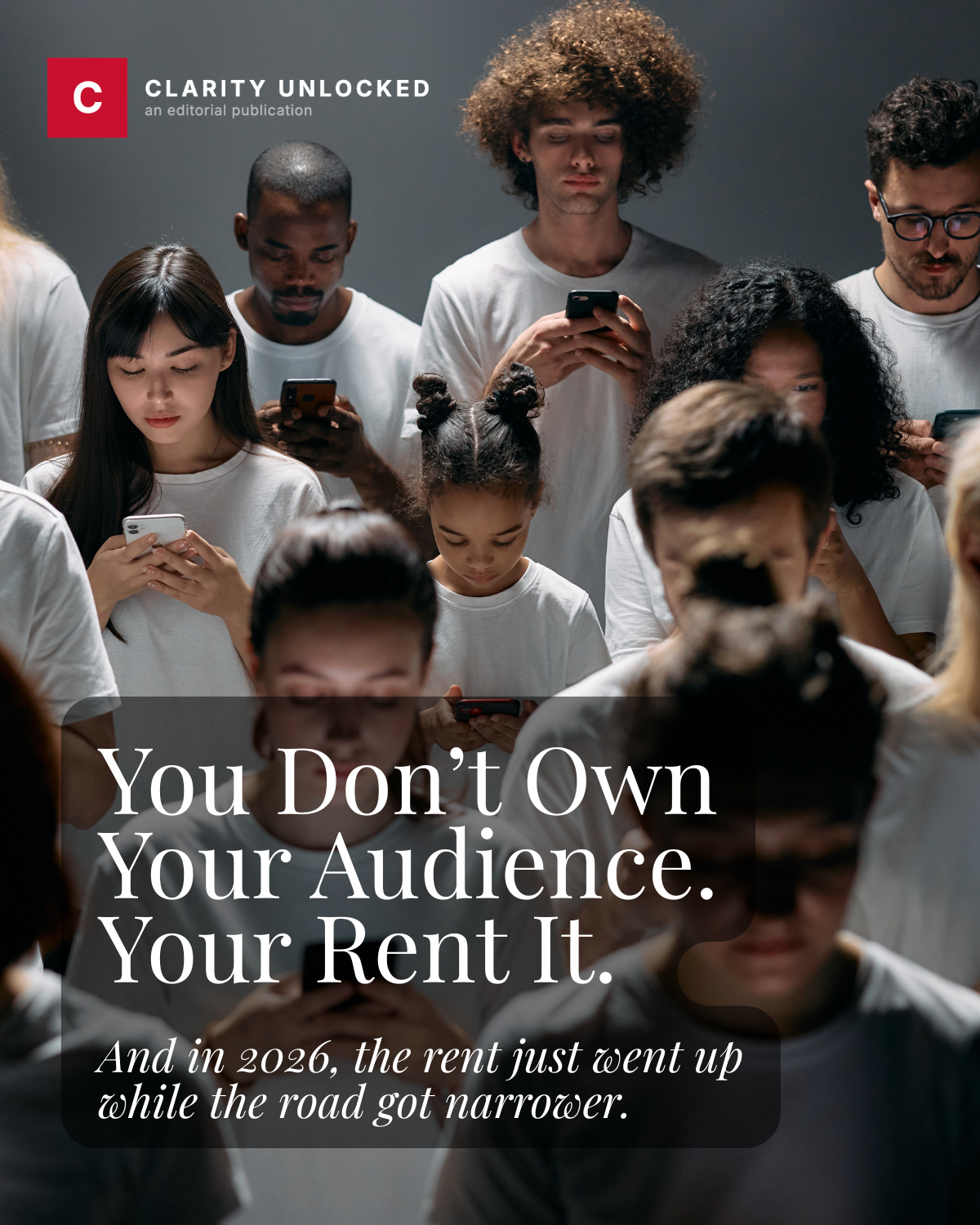
It is wrong on Spotify. It is wrong on TikTok. It is wrong on LinkedIn, YouTube, Instagram, Substack, and every other surface where attention is currently denominated. The platform is not the audience. The platform is the toll booth between you and the audience — and in the second quarter of 2026, the toll is going up while the road gets narrower.
I want to be precise about this because I have watched too many serious people — founders with real product, artists with real catalog, operators with real taste — build their entire growth model on a foundation they do not own and cannot defend. The platforms are landlords. The creator class has been operating as if it owned the building. The math on that is about to get expensive.
This essay is the read on the asymmetry — and the operator's response.
The rent is paid in three currencies
When you build on a platform, you pay rent. You always have. The thing that changed in 2026 is the rate sheet.
Rent is paid in three currencies, and most creators only see the first one.
Attention rent. The algorithm decides who sees your work. You do not. You make the post, the song, the video — and a system you cannot inspect decides whether to show it to ten people or ten million. The default is suppression. Reach is the exception, not the floor. The platform has every incentive to make organic reach a teaser for paid reach, and every platform in 2026 is executing on exactly that incentive.
Money rent. When the organic teaser stops working — and it always stops working — the platform sells you the audience you thought you already had. Spotify calls it Discovery Mode. Meta calls it Boosted Posts. LinkedIn calls it Accelerate. TikTok calls it Spark Ads. The label on the door is different. The transaction is identical — you pay to reach the people who already followed you.
Data rent. This is the one most creators never see, because it is invisible until you try to leave. Every email, every behavior signal, every preference, every play — you generate it, the platform keeps it. You can take your content out. You cannot take the relationships out. There is no export button for who actually loves your work. The platform knows. You don't.
The asymmetry is the product. You produce the value. They keep the leverage.
The 2026 compression event
This is not a vibe-piece. The numbers are doing the talking, and they are talking faster than the conversation can keep up.
Spotify Discovery Mode — the program that promises algorithmic boost in exchange for a reduced royalty rate — is now functionally pay-to-play for any artist who wants their catalog to surface in editorial-adjacent contexts. The trade is a roughly 30 percent royalty haircut for the chance to appear in Radio and Autoplay. That is not a feature. That is a tax on visibility, paid by the artist, owed to a platform that already takes the lion's share of the payout per stream.
TikTok organic reach for non-paying accounts is at the lowest level on record in early 2026, per Social Insider's Q1 benchmarks. The accounts that grew on TikTok between 2020 and 2023 did so on a tailwind that no longer exists. The platform built its growth on creator-fueled reach and is now actively withdrawing that reach to push spend into Spark Ads. The accounts that adapted are renting. The accounts that didn't are dying in public.
LinkedIn's March 2026 algorithm change cut external-link reach by a reported 40 percent. The platform's rationale — keeping users on-platform longer — is a rational business decision for LinkedIn and a structural attack on every creator who uses LinkedIn as a top-of-funnel for an owned destination. Every link to your site, your newsletter, your product page is now algorithmically penalized. The dwell-time economy is what the platform optimizes for. Your conversion path is not.
YouTube Shorts monetization still pays a fraction of what long-form pays per thousand views, and the gap is not closing. Creators who pivoted to Shorts to chase reach are watching reach convert to a revenue model that doesn't pencil. The reach is real. The revenue is not.
Every major platform is simultaneously raising rent and tightening the lease. Most creators notice one platform at a time. The pattern is the story.
Followers are a vanity metric. The list is the asset.
There is a question I would ask every founder, every artist, every operator who is currently building a "platform-first" strategy in 2026.
If the platform shut your account off tomorrow, what would you actually still own?
If the answer is "my followers" — you don't. Followers are a permission slip the platform issued. The platform can revoke that slip with a TOS update, a shadow-ban, a policy change, an algorithm tweak, or a simple no-explanation suspension. It happens every day, to accounts with seven figures of follower count, and the platforms owe no explanation.
A hundred thousand followers and no email list is not a business. It is a tenant with no lease.
The actual asset stack — the one the platform cannot repossess — is much smaller than the dashboard suggests. It looks like this:
- A domain you own outright. Not a Substack subdomain. Not a Linktree. A URL with your name on the registration.
- An email list you have exported and can re-host on any provider in an afternoon.
- A catalog of work that exists on owned infrastructure — your audio files, your master text, your source assets — independent of the platforms that distribute it.
- The IP behind the work. The trademarks, the brand system, the underlying compositions and characters.
- A relationship layer — readers who have shown up to your domain, listeners who have bought your record, customers who have your product in their hand. The relationship existed before the platform mediated it, and it will exist after.
Everything else is a distribution channel. Distribution is good. Distribution is not ownership. The single most expensive mistake in the modern creator economy is mistaking the second for the first.
The POTSH counter-example — distribution, not identity
I want to put this in receipts, because I have built inside it.
POTSH Music — the AI-native music IP studio I founded — released GIRL.CODE's debut EP in September 2025. Five million organic views across the launch campaign. The trio is live on Spotify, on Apple Music, on every major DSP, on TikTok, on Instagram. The catalog moves through the platforms the way a record moves through a radio station — the platform is the route, not the destination.
Here is the structural choice that changes everything.
The artist pages on the DSPs are distribution. The owned layer is potshmusic.com, the seven artist worlds inside it, the email list, the IP filings, the brand system, the source files, the analytics on infrastructure I control. The five million views did not belong to TikTok. They belonged to a catalog and a brand that exist on ground I own.
Every release is a list-builder. Every viral moment is a chance to migrate attention to owned ground. Every platform post is a lead-gen event for an asset the platform cannot revoke. When Spotify changes the payout rate next quarter — and they will — the catalog still exists, the brand still exists, the listeners still exist, the relationship still exists. The route changes. The destination does not.
This is also why FLONYX — POTSH's instrumental focus brand, thirty-one tracks live across DSPs — is being pitched direct to music supervisors as a sync-licensing IP, not as a Spotify play. The DSP is the showroom. The deal is the asset. The same logic applies to nickboyd.com and clarity-unlocked.com — owned editorial layers, full email capture, no rented foundation, no platform that can change the rules between me and the reader.
The platforms are useful. The platforms are necessary. The platforms are not the business.
The operator's posture
Once you see the asymmetry, the operational posture changes. Not theoretically — concretely, in the way you spend your next hour.
Every post is a lead-gen event. The goal of a platform interaction is not the platform interaction. The goal is to migrate the relationship one layer closer to ownership — get the click to the site, get the email on the list, get the listener to the artist page on the owned domain, get the buyer to the checkout you control.
Every release is a list-builder. A song, an article, a product launch, a video — every shipped thing has an owned-destination CTA embedded in it. Not as an afterthought. As the design intent. The release is the magnet. The list is the asset the magnet produces.
Every viral moment is a migration event. Virality is not the win. Virality is a window. The win is what you build during the window — the email captures, the bookmarks, the direct subscribers, the brand recognition that survives the algorithm forgetting you next Tuesday.
Every dollar of paid amplification has an owned-asset outcome attached to it. If your paid spend is buying impressions on a rented surface and not producing a single owned-asset signal, you are not running a growth program. You are subsidizing a platform's revenue with your own.
This is the Hinge Generation read, I think — the people who had analog childhoods and digital adulthoods are uniquely calibrated to see this. We remember what it felt like to own a record collection. We remember when the music was on the shelf, not in the account. The instinct to own the thing is not nostalgia. It is the original architecture of how creative IP actually works, and the platforms have spent two decades training us to forget it.
Five questions for the next quarter
I am going to leave you with the questions I am asking inside POTSH every week. They are not theoretical. They are the operational filter we run every decision through.
1. If this platform shut my account off tomorrow, what would I still own? If the answer is nothing — fix that this week, not next quarter.
2. What percentage of my growth this month came from a surface I control? Owned email, owned site, owned catalog. If the number is under 20 percent, you are not building a business. You are building a tenancy.
3. Where am I paying rent in attention, money, and data — and is the rent producing an owned-asset outcome, or just more platform exposure? Most paid spend fails this test.
4. What is the single asset on my stack that the platform can never repossess? Name it. Defend it. Invest in it. Treat it as the actual product. The platforms are the channel. The asset is the company.
5. If the algorithm changed tomorrow — and it will — what does my next 90 days look like? If the honest answer is I'd be in trouble, you have your roadmap.
The platforms are not the enemy. The platforms are useful infrastructure run by rational businesses that owe you no favors. The mistake is treating the landlord as the home.
Own the layer they cannot revoke. Build everything else on top of it.
The audience was never on the platform. The audience is on the other end of the platform — and the only durable business is the one with a direct relationship to the people who already showed up for the work.
Nick Boyd is the founder and CEO of POTSH Music and the creator of Clarity Unlocked. POTSH Music's debut album, Music Is My Religion, releases June 5, 2026.