The cheap version of this essay is the one you have already read. AI will replace your agency. The freelancer is over. Marketing departments are about to get small. Those headlines are not wrong, exactly. They are just lazy. They mistake a symptom for the system.
The real story is on the buyer side, not the supplier side. The professional services bill — the line item every company carries for agencies, freelancers, consultancies, retainers, fractional specialists, and the long tail of people you pay to coordinate things you could in theory coordinate yourself — is about to compress. Not because the people doing that work got worse. Because the reason that work existed in the first place is being dismantled.
I am writing this from inside the experiment. POTSH Music is twelve months in as an AI-native music IP studio. One human in the loop. No agency. No outside freelancer. No consultancy on retainer. The books are legible now in a way that, two years ago, would have been a thought experiment. They are now a balance sheet. And what the balance sheet says is the part the cheap version of the essay misses.
The eight-role stack that used to cost a million dollars
The traditional version of what I am building required, conservatively, eight specialist roles to operate at a credible standard. A&R. Brand and creative direction. Producer. Product and release planning. IP attorney on retainer. PR. Marketing and growth. A chief of staff to coordinate the other seven.
Fully loaded, with benefits and overhead, that stack ran north of a million dollars a year. That is not a Manhattan number. That is a normal, indie, taste-driven creative business. Indie publishing houses. Boutique fashion labels. Mid-sized creative agencies. Specialty consumer brands. Same eight slots, different titles.
The bill was not vanity. Each of those eight people existed because the work genuinely required eight different kinds of attention, and one person could not credibly hold all eight in their head at once. Coordination cost — meetings, briefs, status, revisions, sign-offs — was the tax you paid to keep eight specialists pointed in the same direction. That tax compounded. Most of what looks like "the cost of doing business" in a creative company is actually the cost of coordinating between specialists who do not naturally share context.
Six of those eight collapse into a workflow
What an AI-native operator does — and this is the part you cannot grasp without doing it for at least six months — is collapse most of those roles into a single workflow that one person actually runs.
A&R becomes a taste filter applied to generative output and live signal. Brand and creative direction become a system prompt, a moodboard, and a hand. Producer becomes a session with a model that does not get tired, that does not require booking, that does not have an opinion about your idea unless you ask for one. Product and release planning become a Notion doc and a calendar. Marketing and growth become a writing practice plus a tracking pixel. PR becomes the founder telling the story themselves, in their own name, on the record.
Six of those eight roles, in 2026, are not "augmented" by AI. They are dissolved by it. The work still gets done. The role does not survive the doing.
The two that survive are the two where judgment lives at the edges and where craft is non-fungible. Legal at scale — the kind of IP defense or trial-grade litigation where the cost of being wrong is structural — does not collapse. And taste at the highest level, the kind that decides whether the work is any good, does not collapse either. Those two are getting more valuable, not less. Everyone else in the middle is getting repriced.
The new buyer profile is one person with a credit card
Here is the part the SaaS industry has already figured out, even if the analysts have not.
The buyer profile for software, compute, and specialist services in 2026 is not the enterprise team. It is one person with a credit card, an opinion, and a release calendar. Look at the pricing pages. Lovable, Cursor, Beehiiv, ElevenLabs, Suno, Linear, Replit, v0, the wave of vertical SaaS that does not get covered yet — every one of them has, in the last twelve months, repositioned around the indie operator. Solo tier. Pro tier. Team-of-one tier. The "team" tier is the upsell, not the default.
That is a tell. Pricing pages do not lie. They are the most honest document a software company produces, because pricing is where the company has to admit who is actually paying. And the company that used to design for a fifty-seat sales motion is now designing for a one-seat self-serve motion, because that is where the volume is going.
The agency model and the venture-funded enterprise SaaS model were built on the same hidden assumption — that coordination is expensive and that the buyer can afford to pay for someone else to do it. Both assumptions are being repriced at the same time, by the same force, for the same reason. When the coordination tax goes to zero, the things built on top of that tax get cheaper or disappear.
The collapse-risk taxonomy
I have been keeping a list. Not a prediction. A description of what I have actually stopped paying for, watched peers stop paying for, and watched the market quietly accept as the new default.
Collapsing inside 24 months. Brand strategy decks. Marketing operations. Social media management as a standalone retainer. Junior copywriting. Basic legal templates. Junior design execution. Research synthesis. Project management as a billable role. Most of what gets called "agency of record" for a sub-$50M company. Editorial production for routine content. Standard market research reports.
Holding, for now. Specialized B2B sales motions that require human relationships. Physical production at scale. Regulated industries where the buyer needs a name on the document. Crisis communications when reputational risk is existential. Original journalism. Anything where the cost of being wrong is paid in lawsuits or lives.
Appreciating, not depreciating. Trial-grade litigation. Specialized IP defense. Taste-level creative direction at the highest tier. Real reporting that breaks something. Fractional finance for genuinely complex situations. Production where physical execution still matters and where logistics are the moat. Strategy at the level where being right is rare and being wrong is expensive.
The pattern is not "AI does the cheap stuff and humans do the expensive stuff." The pattern is AI does the coordination, humans do the consequence. If your work is mostly coordinating between other specialists, your work is at risk. If your work is the place where consequence accrues — where someone has to be on the hook — your work is appreciating.
Agencies and freelancers were always a workaround for latency inside large organizations. When the latency disappears, so does the workaround.
What an AI-native creator actually buys with the money
This is the receipts part. What did I actually spend the money on, once the agency and freelancer line items came out?
Software subscriptions, denser than I expected. The stack POTSH runs on costs more than a small team's worth of SaaS used to, because each tool is doing the work of a former specialist. The line item moved from "people" to "tools" — and the dollar amount went down by an order of magnitude, even with the denser stack.
Compute. Real compute. Generative models at production scale are not free, and I am not interested in the cheapest tier. The good version of the work costs money in tokens, in renders, in storage, in API calls. I pay for it.
Specialist judgment where I genuinely cannot substitute. An IP attorney for the contracts that actually matter. A mastering engineer for the final stage where ears still beat algorithms. A photographer for the brand photo where the image is the brand. These are not retainers. These are projects. The relationship is per-engagement, not per-month.
Distribution and infrastructure. DSP fees, hosting, analytics, the unglamorous plumbing that makes the work reachable. This category grew, because reach is what I am buying when I am not paying a marketing agency to manufacture it.
What disappeared, in dollar terms: the agency retainer that used to be the single largest line item on the marketing budget. The freelancer roster that used to absorb everything the agency would not do. The consultancy engagement that used to be the cover story for a decision the founder already wanted to make. Gone. Not reduced. Gone.
The reader question is not what you think it is
The cheap question is will I be replaced. That question is, structurally, useless. It assumes a binary outcome on a continuous trend, and it puts the asker in a passive position relative to a market that does not care.
The useful question — the one I have asked myself, asked my peers, and now ask you to ask — is this. What am I currently being paid to coordinate, and would a competent operator with the right tool pay me to do that work in 2027?
If the honest answer is yes, you are fine. The coordination you provide is, in some way, irreducible — taste, relationship, accountability, physical presence, specialized judgment. The market will keep paying.
If the honest answer is no, you have eighteen to twenty-four months to move up the stack. To stop being the coordinator and start being the consequence. To take a position where being wrong is expensive and being right is rare. The agencies and consultancies that survive this cycle will be the ones that figured this out in 2026. The ones that did not will spend 2027 explaining why their retainers should stay the same size.
The professional services bill is the next thing to collapse. Not because the people inside it are obsolete. Because the latency they were a workaround for is gone. And the buyer — one person with a credit card, an opinion, and a release calendar — has already started repricing the market without waiting for anyone's permission.
The balance sheet says so. The pricing pages say so. The receipts say so.
The only question left is whether you are the one paying the old bill or the one writing the new one.
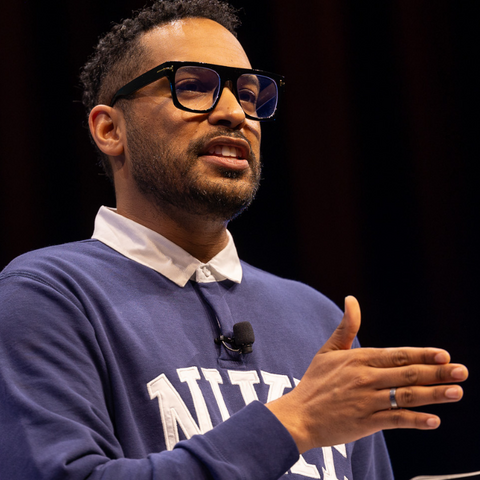
Nick Boyd is the founder and CEO of POTSH Music and the creator of Clarity Unlocked. He spent twenty years at Nike, Target, and Gap Inc. before building the first AI-native music IP studio from Portland, Oregon.